

Motorik Kasar: Tahapan Usia dan Cara Stimulasinya
Motorik kasar adalah kemampuan gerak otot besar. Kenali tahapan usia, contoh stimulasi yang aman, dan tanda keterlambatan pada anak.
2026/10/28
AceKid
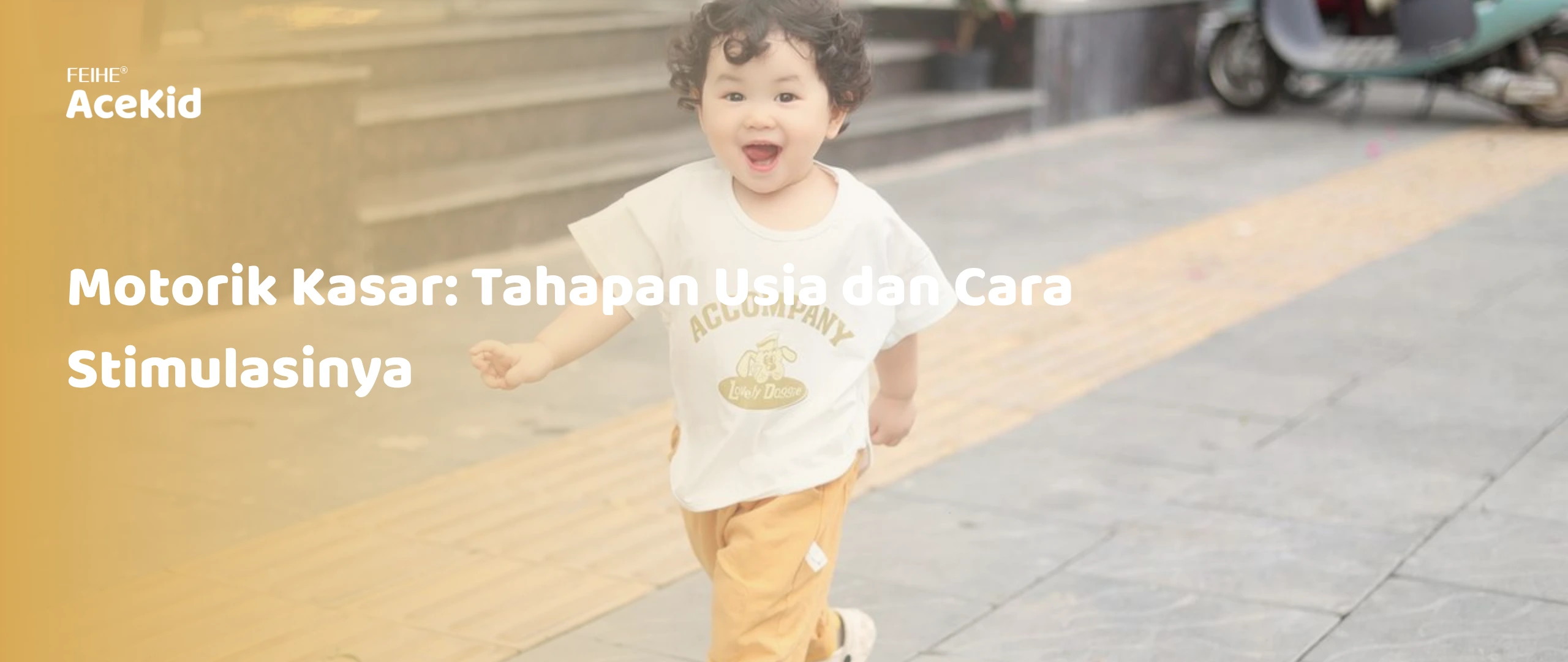
Gross motor skills are the ability to move the large muscles in the arms, legs, and trunk to maintain position, balance, and move around. Examples include lifting the head, sitting, walking, running, and kicking a ball.
Seeing other children walking while yours is still crawling can be worrying. However, development should be assessed based on age-appropriate abilities, visible progress, and quality of movement, not comparisons with one child.
The following guide helps you understand early childhood gross motor skills, choose safe play, and recognize when a checkup is needed.
What Are Gross Motor Skills in Children?
Body movement requires the brain, nerves, muscles, and bones to work together. When a child stands up to pick up a toy, their body simultaneously regulates leg strength, trunk position, and balance to prevent falling.
In play activities, examples of gross motor skills can be grouped into:
- Locomotor: movements that move the body, such as crawling, walking, running, and jumping.
- Non-locomotor: movements in place, for example bending, turning, or stretching.
- Manipulative: movements to control objects, such as throwing, catching, and kicking a ball.
In general, motor control develops from the head to the feet, known as a cephalocaudal pattern. Body control also develops from the center to the more distant limbs, called proximodistal. This pattern helps understand development, not a rigid schedule for every child.
What is the Difference Between Gross Motor Skills and Fine Motor Skills?
Both support each other and develop through everyday experiences. Fine motor skills don't need to wait until all gross motor skills have been mastered.
| Aspect | Gross motor skills | Fine motor skills |
| Main movement | Large movements and posture adjustments | Smaller, more precise movements |
| Example | Sitting, running, jumping | Pinching objects, drawing, buttoning clothes |
| Daily roles | Moving around and maintaining balance | Using tools and working on details |
When a child draws, the trunk muscles help maintain a sitting position, while the fingers control the crayon. Therefore, play opportunities should include full-body movements as well as hand activities.
Gross Motor Skills for Children Aged 0-6 Years
Milestones are skills typically achieved by a certain age. The CDC uses the skills most children already have, at least 75%, as a benchmark for monitoring. This list helps open a conversation with a doctor and does not replace developmental screening.
| Reference age | Examples of monitored capabilities |
| Early life | Moves arms and legs and begins to practice lifting head while lying on stomach. |
| 4 months | Head is stable when held upright; rests on elbows when prone |
| 6 months | Roll from prone to supine; support sitting position with hands |
| 9 months | Sitting without support and moving to a sitting position on your own |
| 12 months | Pulling the body to stand and walk holding onto furniture |
| 18 months | Walking without holding on |
| 24 months | Run, kick a ball, and walk up a few stairs with or without assistance |
| 30 months | Jump with both feet off the floor |
| About 3 years | Expanding balance exercises, ball games, and learning to pedal a tricycle |
| 4 years | Catching the big ball on most attempts |
| 5 years | Jumping on one leg |
| About 6 years | Developing more complex coordination, such as learning to jump rope and ball games |
The age ranges between 3 and 6 years old represent skills that develop through practice, not diagnostic boundaries. Don't interpret the chart as requiring your child to master all sports by their birthday.
Walking independently isn't yet a mandatory goal at 12 months. Similarly, some babies move by shimmying or crawling without the traditional crawling pattern. Continue to pay attention to symmetry, progress, and any other concerns.
For premature babies, the assessment generally uses the corrected age for the first two years. For example, a baby born eight weeks premature who is now four months old has a corrected age of approximately two months. Confirm this with your doctor.
Why is Gross Motor Development Important?
The ability to move helps children reach objects, participate in games, and carry out daily activities more independently. The experience of trying, failing, and then trying again also provides opportunities to learn to solve problems.
When playing ball together, children practice coordination, take turns, and follow simple rules. Physical activity supports fitness, bone health, and muscle health. However, walking faster doesn't automatically mean being smarter.
To accompany the changing needs of toddlers, you can also explore the guide for children aged 1-3 years according to their developmental stage.
Factors Influencing Gross Motor Development
Opportunities for movement, health conditions, and birth history all influence development. Children who spend most of their time in a car seat or stroller have fewer opportunities to practice on the floor, but delays shouldn't be automatically attributed to parents.
Prematurity, neurological or muscular disorders, genetic conditions, bone and joint problems, and nutritional deficiencies may require specialized assessment. The cause cannot be determined solely from a brief video or a single skill that has not yet emerged.
If your child is having difficulty gaining weight , bring growth charts to your appointment. Weight and height provide information about growth, while motor skills still need to be assessed separately.
When Should You Consult a Doctor?
Contact a doctor or health worker if your child has not reached the expected abilities, especially:
- At 4 months, the head is not yet stable when held upright.
- At 9 months old, he was not yet able to sit without support.
- At 18 months, not yet walking independently.
- The right and left movements appear unbalanced, or the body is very stiff or very weak.
- Children lose skills they have previously mastered.
Don't wait until the next age limit if you're already concerned. Loss of ability requires immediate assessment, especially if it occurs suddenly. A doctor can perform an examination, conduct a developmental screening, and determine the need for referral or intervention.
Bring the KIA book and short videos of your child's movements during daily activities. Note when abilities first appear and any pain, fatigue, or other changes. This information will aid the examination without using the videos as a diagnostic tool.
How to Stimulate Gross Motor Skills at Home
Baby: Floor Play and Tummy Time
Practice tummy time while your baby is awake and under direct supervision, on a flat, sturdy surface. Start with short sessions of about 3-5 minutes, two or three times a day, then gradually increase as tolerated.
The WHO recommends a total of at least 30 minutes of tummy time spread throughout the day for babies who are not yet mobile. This target should be gradually increased. For sleeping, keep the baby on their back.
Place your face or a safe toy near your baby to encourage them to lift their head and reach. Stop the session if your baby is very uncomfortable, drowsy, or having difficulty breathing. Avoid forcing them to stand before they're ready.
Toddlers: Balls, Dance, and Simple Obstacle Courses
Encourage your child to roll and kick a soft ball. Create a short path using floor markers or low, stable pillows. Be a close observer and adjust the challenge to their existing abilities.
Model the movement, then let your child try. Praise specific efforts, for example, "You're trying to step over the line." These short, fun sessions can be repeated in between routines without turning them into tests.
For children aged 1-2 years, the WHO recommends at least 180 minutes of varied activity throughout the day. This includes light movement and active play, but not three consecutive hours of vigorous exercise.
Preschool: Balance and Cooperative Play
Try walking a line, dancing when the music stops, catching a large ball, or simply hopscotch. Use a barrier-free space, a non-slip surface, and equipment appropriate for your child's size.
At ages 3-4, the recommended daily activity level remains at least 180 minutes, including at least 60 minutes of moderate to vigorous activity. Spread activities throughout the day and allow for breaks.
Avoid Baby Walkers with Wheels and Seats
The AAP does not recommend this type of baby walker due to the risk of falls, burns, and contact with dangerous objects. It also does not teach babies to walk.
Prioritize safe floor areas and sturdy furniture to hold onto. Even push toys require the child's readiness, stability, and supervision; their use does not guarantee faster walking.
Complete the Game with an Adequate Diet
Provide a variety of age-appropriate foods , including sources of protein, carbohydrates, fats, vegetables, and fruits. If considering milk for toddlers , learn how to choose milk for ages 1-3 and how to read milk ingredients .
AceKid Stage 3 is intended for ages 12-36 months. Milk can supplement a child's diet as needed, but it does not replace stimulation or screening for motor delays.
Breast milk is the best food for babies. The WHO recommends exclusive breastfeeding for the first 6 months of life. AceKid fully supports breastfeeding.
Frequently Asked Questions
Does not walking at 12 months mean it is too late?
Not necessarily. At 12 months, skills monitored include standing and walking with support. If your child hasn't walked independently by 18 months, consult a doctor. Seek medical attention sooner if there are other concerns.
Do all babies have to crawl?
No. Some babies use other methods of moving. Pay attention to their progress and use of both sides of their body; consult a doctor if movement is uneven or you have concerns.
Does a baby walker help a child walk faster?
No. Wheeled baby walkers with seats do not teach walking and pose a risk of injury. Provide opportunities for movement in a safe, supervised area.
Does gross motor skills have to be completed before fine motor skills?
No. Both skills develop simultaneously and support each other. Provide a variety of movement games and hands-on activities according to your child's readiness.
Is motor delay sufficiently addressed with stimulation?
Not always. Stimulation helps with training, but delays can have medical causes. The doctor will determine whether the child needs additional testing or therapy.
Conclusion
Gross motor skills develop through physical maturity and opportunities for movement. Choose games that are appropriate for your child's readiness, monitor their progress, and avoid comparing achievements. If skills are not yet emerging or are missing, consult with your child so their needs can be identified early.
Reference Source
Cleveland Clinic. Gross Motor Skills. https://my.clevelandclinic.org/health/articles/gross-motor-skills
NSW Department of Education. Get Skilled: Get Active. https://education.nsw.gov.au/content/dam/main-education/teaching-and-learning/curriculum/key-learning-areas/pdhpe/media/documents/pdhpe-k-6-get-skilled-get-active-resource.pdf
Surendranath College. Themes of Development: Cephalocaudal and Proximodistal. https://www.surendranathcollege.ac.in/uploads/1753182123_PAPRI_MANNAThemesofDevelopment2021-01-213.ThemesCephalocaudalandProximodistal.pdf
Department for Education. Fine motor skills. https://help-for-early-years-providers.education.gov.uk/areas-of-learning/physical-development/fine-motor-skills
CDC. Milestones by 4 Months. https://www.cdc.gov/act-early/milestones/4-months.html
CDC. Milestones by 6 Months. https://www.cdc.gov/act-early/milestones/6-months.html
CDC. Milestones by 9 Months. https://www.cdc.gov/act-early/milestones/9-months.html
CDC. Milestones by 1 Year. https://www.cdc.gov/act-early/milestones/1-year.html
CDC. Milestones by 18 Months. https://www.cdc.gov/act-early/milestones/18-months.html
CDC. Milestones by 2 Years. https://www.cdc.gov/act-early/milestones/2-years.html
CDC. Milestones by 30 Months. https://www.cdc.gov/act-early/milestones/30-months.html
CDC. Milestones by 4 Years. https://www.cdc.gov/act-early/milestones/4-years.html
CDC. Milestones by 5 Years. https://www.cdc.gov/act-early/milestones/5-years.html
IDAI. Understanding Common Developmental Delays in Children. https://www.idai.or.id/artikel/seputar-kesehatan-anak/mengenal-keterlambatan-perkembangan-umum-pada-anak
American Academy of Pediatrics. Corrected Age For Preemies. https://www.healthychildren.org/English/ages-stages/baby/preemie/Pages/Corrected-Age-For-Preemies.aspx
American Academy of Pediatrics. Movement Milestones in Babies 8 to 12 Months Old. https://www.healthychildren.org/English/ages-stages/baby/Pages/Movement-8-to-12-Months.aspx
American Academy of Pediatrics. Baby Walkers: A Dangerous Choice. https://www.healthychildren.org/English/safety-prevention/at-home/Pages/baby-walkers-a-dangerous-choice.aspx
NIH NICHD. Benefits of Tummy Time. https://safetosleep.nichd.nih.gov/reduce-risk/tummy-time
WHO. To grow up healthy, children need to sit less and play more. https://www.who.int/news/item/24-04-2019-to-grow-up-healthy-children-need-to-sit-less-and-play-more
这篇文章对您有帮助吗?